Friday, August 27, 2010

Cities and towns of Bretagne

Although we spent a good deal of time driving/walking along the coast or on small country roads, Brittany (aka Bretagne) has some beautiful inland cities and towns as well. We were happy to see how many buildings survived the bombings of WWII and the architecture unique to this part of France.

We mentioned Dinan earlier, but Paul feels it deserves a few more photos.....While there, we saw a wonderful show of Robert Doisneau photographs dating before, during and after WWII.


From the top of the clock tower we could see most of Dinan.
Paul snuck a picture of this atypical tourist couple on an old world shopping street
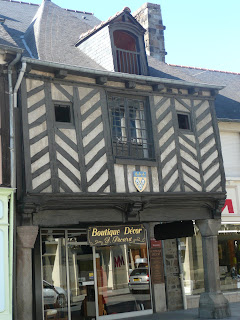
Lots'a very old homes dating from the 15thC

Another day we visited Bretagne's capital city, Rennes, a bustling historic city that has a modern Italian feel to it with bright colors and high design. Yet, like Dinan, it has many beautiful old half-timber and stone buildings

and this more modern art deco swimming pool. The detail of the ceramics on the right.


The building and gardens below are typical of Rennes'
public buildings.


Dol de Bretagne boasts the oldest "maison" in Bretagne,
with many homes dating back to the 11c


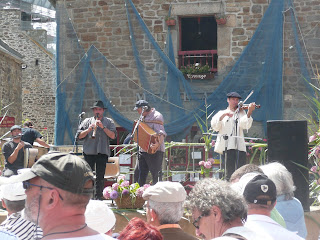
We visited St. Sulliac along the Raunch River which flows out to sea at St-Malo. St. Sulliac hosted a festival that drew huge crowds, with flower and fishnet decorating the old stone houses and some locals dressed as in the olden days, ladies bloomers on the clothes line...


We arrived early and the cooking sausages made everyone hungry,


but by the time we decided on the best spot to buy food the line for the ham shank with potato, turnip and carrots was 20 minutes long. It tasted great down by the water though....

Then came the music and dancing


Great fun for two people who cant chat with anyone, although Paul had a friendly conversation in the porta-potty (wish we knew the French for that) line in English with a man who lives in Paris but comes home to St Sulliac several times each year. For the most part we take it all in, smile, eat and enjoy the music and sunshine.

Saturday, August 7, 2010

Chateau Hopping in Bretagne


We've seen some beautiful old chateau, around the countryside. Not the refined country homes of the very wealthy found in the Loire Valley, these are huge defensive fortresses.

We first encountered a smaller one with many walls falling down but the four main towers intact. It's Chateau de la Hunaudaye (Paul's favorite),

which we first visited after closing time and without much light, but we returned to investigate further and caught these views with some sunlight support


Another day we journeyed south to a lovely old-world town of Vitre. Its fortified chateau, ramparts


and small streets are just as they were 500 years ago. In those days the town thrived producing hemp, woolen cloth and cotton stockings sold throughout Europe and even America and the Indies. The tradesmen built beautiful half-timbered homes, many of which still stand. And, of course, their lovely old church right in the middle.

The Cathedral isn't really tilted; it's the photographer.

From Vitre we headed back north to Fougeres. On the border of Brittany and France everyone wanted it, so it acquired great military importance in the early middle ages. In 1166, Henry II surrounded the castle which capitulated after a 3 month seige, but throughout the centuries many other leaders were defeated and the fief passed onward to many noblemen. After Brittany and France unified around 1532, there was a succession of governors, then it was used as a prison. The town bought the castle in 1892.


On to Combourg where the castle dates back to the 11C, some parts restored in the 19C. The great French writer Chateaubriand lived here in the almost deserted castle with stern silent parents in 18C, sharing the loneliness, boredom and haunted castle feelings only with his sister.


Danice at the Henri II Port at the Chateau.

And last, could be least depending on one's perspective, we followed a barely marked turn-off from a small country road to look for an abandoned Chateau. Parking was provided next to a cow pasture, but no Chateau or further signs in sight. So we bid the cows a kind bonjour and treaded across their pasture, up a hill and down a charming wooded path to finally see the remains, surrounded by weeds and thicket. Quite a contrast to the perfectly landscaped castles and cathedrals other towns proudly display.


That's it for Chateau.
We hope to do one more post, and Paul has grandiose plans for putting more pics somewhere on the web. Bet you can't wait for that. Home soon.


Wednesday, August 4, 2010

Capturing the Sun - Cote d'Emeraude


We've been playing hide and seek with the Bretagne sunshine. Since nobody loves a loser or a dark gloomy photo, we'll do our best to share just our wins. The north coast seems to have hundreds of beautiful cliffs jutting out into the water with amazing views of up to 270 degrees and lots of rocky places to climb down and around. They're all great if the sun deigns to shine, but they lose their sparkle when the sun hides behind thick clouds. Looks like this, but imagine turning your head to see more and more.


There you see? All those clouds coming in on the next shot.... we took a walk and had a Limone, but the much worshiped sun wasn't coming back. So we headed inland to a Medieval town named Moncontour.


Moncontour has walls and a church from the 12c, with improvements along the way. The Germans, ergo the allies left it alone in WWII, so it stands in it's very ancient manner today. They are justly proud of the beautiful stained glass windows in the church.


This one is a detail of a much larger window in the church


Then we drove through beautiful French countryside to Chateau de la Hunaudaye, also built in the 12th c with later additions. It had closed at 6:30PM, but we could walk around it. Paul wants to return when they're open, as he loves climbing all over and through old fortresses.


Driving homeward we enjoyed the small villages and farms, the smell of new mown grass and hay and the sights of farm animals. Then we stopped for dinner and ate some of them.

Saturday, July 31, 2010

Leaving Paris - Arriving Saint-Malo


Paris doesn't make it easy to say goodbye. Our last days we had to go back to the old favorite haunts. The Orangerie filled with those nothing-else-like-them-like-ever wall length Monets and the wonderful Paul Guillame collection d ownstairs, the W.H. Smith Bookstore, around and through the 7th, 6th, 5th and 4th arrondisements, and one more visit to the Musee D'Orsay... (Such a perfect place, I wish they'd allow us to scatter our ashes there.)

Monday 7/26, we packed, cleaned the apartment (Paul got a little compulsive, but it looked great when we left, aside from the sheets and towels hanging to dry all over the bathroom), taxied to Gare Mont Parnasse and were soon on our way to Saint-Malo. Sophie and David had already arrived at our home the day before, thanks to the wonders of internet home exchange and jet air travel. We were so happy to see Anna, mother of Sophie, holding a sign with our names and photo from the home exchange web site. Anna and her husband drove us to the very nice large apartment inside the fortress walls of St. Malo, showed us the apartment and where the car was parked, and left us with keys and a bunch of beautiful fresh veggies and a flower bouquet from her garden. Oops, forgot to mention the apricot and framboise home made jams she left us.

Even on a bright day and with lots of windows, it's still kinda dark inside the walls of a fortified town, and our arrival day and the next were overcast. The sea just outside the wall was beautiful, but the sky was grey. We wondered if perhaps 2.5 weeks was too long to stay, but we remembered that we always feel a certain yuck factor when we don't know what the heck we are doing - so we gave it some time and started getting oriented. Great ramparts, too many tourists, loads of Creperies, a few good restaurants, a small public market, really old church not destroyed by the allies, amazing low tides with long flat beaches tempting one to walk out to distant forts, but watch out for the tides coming back in - signs warn you to stay there half a day til the tides again ebb!

Next day, still overcast, we took the car, figured out the GPS and set off to tour the Cote de Emeraulde, driving west along the beautiful coast line. Families of all ages show up in droves at low tide to walk amazing distances out onto the wet beaches to dig for shellfish.
Note: those teeny tiny dots in the photo are people, there were over a hundred.
We covered four of the many peninsulas that project north into the English Channel and were surprised by the number of thriving resort towns with beautiful homes and beaches.

We climbed the watch tower at Fort La Latte


for stunning panoramic views of the coast line (so hard to capture with a point and shoot), and walked around Cap Frehel.

Brittany is named for the migrant Britons from Cornwall and Wales who settled here about 450AD, but these two forts were used to repel invasions from Brittish and others since the 14th century. Bretagne residents felt they were a country unto themselves, not beholding to France or England.

The following morning the sun shone brightly in a big blue sky. We took the water bus a 10 minute ride across the inlet or outlet to Dinard, a resort town "discovered" around 1850 by an American who built a big home on the cliff with a magnificent view.

He was followed by many more wealthy Americans and Britons. The town focuses around three beautiful wide sandy beaches filled with adults and many playful children running, swimming, digging, building.

A promenade offers a long walk along the beaches and below the cliffs, with breath taking vistas of St. Malo, sail boats, rock outcroppings and distant lands. Paul's camera just couldn't capture the amazing panarama. We are darned proud of the views of SF bay and the GG Bridge, but these vistas were close rivals... unfortunately our camera does not capture the spectacular panorama, so we'll leave it to our memory and your imagination.


We saw ads for an art show called HOPE, so we found the museum and really appreciated it. Not sure why Paul liked the above piece so much, it had beads and sequins, carefully sewn all over it. There were also videos and a huge painting of Obama. The one that touched Danice most, was this photo of a poor donkey adrift in a small boat. Let's hope he had HOPE.

Friday and mostly cloudy, a drive35 km south and west to Dinan. It's Vieille Ville (old town) has beautifully restored (after WWII) half-timber houses

and stone buildings of the earlier 15th to 17th century architecture. The cobblestone streets and stone houses are reassembled from the bombing rubble. As in many areas of France, a church may have walls and apses and towers ranging from the 12th century to the 18th. It's so exciting to see the buildings that represent the investment of so much time and hard hard work and people's lives. That and the amazing scenery are what keep us traveling. Well, but then there's the food too.